


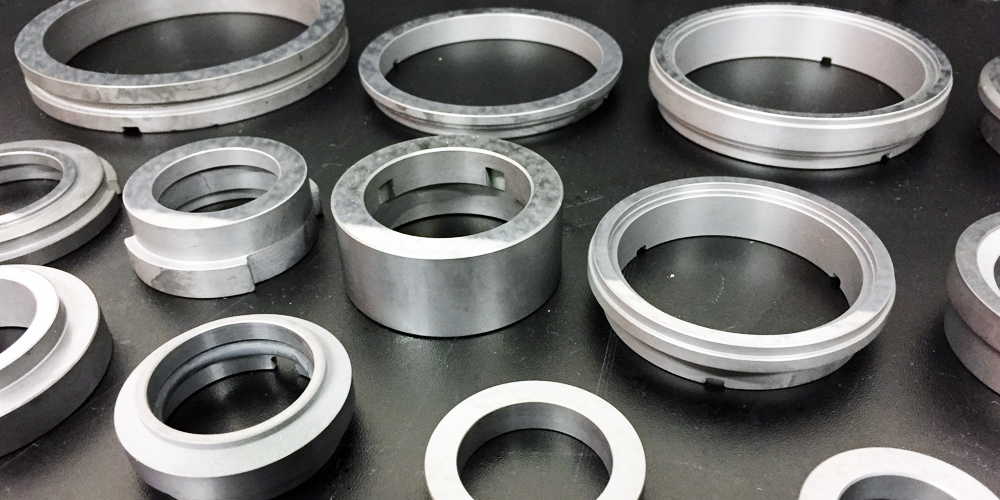
Silicon carbide (SiC) is one of the most important seal face materials for mechanical seals. At Qseals we work with all kinds of materials, including rubber, metal, ceramics and graphite, and each material suits a different situation. After diamond, silicon carbide is one of the hardest materials there is. That’s why it’s used not only for grinding and polishing, armour and brake discs, but above all as a wear-resistant seal face in mechanical seals. On this page you’ll read what silicon carbide is, the difference between reaction bonded SiC, sintered SiC and graphite silicon carbide (G-SiC), and which grade best suits your application.
What is silicon carbide?
Silicon carbide (SiC), also known as carborundum, is a very hard material widely used for grinding and polishing, in the form of grinding stones and polishing and grinding powders.
Granular silicon carbide is produced on a commercial scale by a reaction at very high temperature. High-quality silica sand and carbon (usually petroleum coke) are mixed in the right ratio. This mixture is built up into a heap. In the middle of the heap is a graphite core that acts as an electrical conductor. The graphite core is connected to a transformer and energised. Because of the resistance, the temperature in the core of the heap (the furnace) rises to around 2,700 °C.
The material has been used as a seal face material for mechanical seals for around 30 years. It’s a ceramic and belongs to the ‘hard’ seal faces. Silicon carbide can be used as a rotor and/or stator, depending on the design, the application and the mating face material. Contact us for advice on the different seal faces and combinations.
Benefits of silicon carbide seal faces
- Very high hardness and wear resistance, even with abrasive media
- Good thermal conductivity, so frictional heat is dissipated quickly
- Broad chemical resistance
- Low friction and a long service life
- Can be paired with carbon graphite, tungsten carbide or silicon carbide as the mating face
Reaction bonded SiC, sintered SiC and G-SiC: what’s the difference?
For mechanical seal faces we supply three types of silicon carbide: reaction bonded SiC (RB-SiC, also called SiSiC), sintered SiC (SSiC) and graphite silicon carbide (G-SiC). All three are very hard and wear-resistant, but differences in composition and production give each its own strengths.
Reaction bonded SiC (RB-SiC)
In reaction bonded SiC, a preformed part made of silicon carbide and carbon is infiltrated with liquid silicon. The silicon reacts with the carbon to form new silicon carbide, and the remaining pores are filled with free silicon. The result is a dense material with a small proportion of free silicon.
- Excellent thermal conductivity and good dry-running properties
- Good resistance to thermal shock
- Hardly any shrinkage during production, so suitable for large and complex shapes
- More economical than sintered SiC
- Less suitable for strong alkalis and certain acids, which can attack the free silicon
Sintered SiC (SSiC)
In sintered SiC, very fine silicon carbide powder with a small amount of sintering aid is pressed and sintered at very high temperature. It contains no free silicon, so you get virtually pure silicon carbide.
- Excellent chemical resistance, including against strong acids and alkalis
- Very high hardness and wear resistance, even with abrasive media
- Suitable for high temperatures
- Slightly more sensitive to thermal shock than RB-SiC
- More expensive to produce
Graphite silicon carbide (G-SiC)
G-SiC, or graphite silicon carbide, is a composite of silicon carbide and graphite. It combines the extreme hardness and chemical stability of silicon carbide with the self-lubricating properties of graphite. There are several grades, such as sintered SiC with free graphite dispersed in the SiC matrix, or electrographite infiltrated with silicon. The graphite acts as a built-in lubricant. As a result, G-SiC seal faces cope much better with dry running and poor lubrication than standard silicon carbide, while keeping the hardness and wear resistance of SiC. At Qseals we supply G-SiC seal faces for applications where dry running is a risk.
- Lower friction: the free graphite in the SiC matrix lowers the coefficient of friction compared with pure sintered SiC
- Better emergency running: the seal face tolerates dry running and boundary lubrication much better when the fluid film is temporarily lost
- Resistant to thermal shock and blistering: rapid temperature changes and large temperature differences are handled well, without severe heat checking
- Easy to machine and assemble: thanks to its grain structure, G-SiC is particularly well suited to special and split mechanical seal designs
G-SiC is widely used in pumps and agitators in the process industry, with chemicals, hydrocarbons and water. It also gives extra reliability with volatile and low-boiling fluids, where lubrication is often minimal. Depending on the medium and the abrasive load, you pair G-SiC with carbon graphite, ceramic or a silicon carbide mating face, in a hard-on-soft or hard-on-hard combination.
RB-SiC, SSiC and G-SiC side by side
| Property | RB-SiC | SSiC | G-SiC |
|---|---|---|---|
| Free silicon | Yes, small proportion | No | Depends on grade |
| Chemical resistance | Good, less so with strong alkalis and acids | Excellent | Good |
| Thermal shock resistance | Very good | Good | Very good |
| Friction | Low | Low | Very low |
| Dry running | Good | Good | Excellent |
| Price | More economical | Higher | Higher |
| Typical application | Water, oil, neutral media | Aggressive chemicals, abrasive media | Risk of dry running, poor lubrication, volatile media |
Which one should you choose?
For most applications with water, oil and neutral media, RB-SiC is a reliable and economical choice. Working with aggressive chemicals, strong alkalis or acids, or highly abrasive media? Then sintered SiC is the safest choice. Could your seal run dry, is lubrication poor or variable, or are you handling volatile fluids? Then choose G-SiC. Not sure? Our specialists will gladly look at your medium, temperature and pressure with you.
Custom silicon carbide parts
Do you have a drawing or a sample? Send it to us and we’ll make the part to size in silicon carbide, in either RB-SiC or sintered SiC. That can be seal faces, but also bearing bushes and other silicon carbide parts. We’ll gladly advise you on the grade that best suits your medium, temperature and load. Send a sample or drawing to [email protected] and request a quote.
Knife seals (knife mechanical seal)
These are mechanical seals with a knife-edge seal face in silicon carbide or tungsten carbide. A knife seal face can cut itself free with a fouling or crystallising product. We can supply knife seals in silicon carbide, also compliant with FDA and EC1935-2004. Having trouble with your mechanical seals because your product contains a lot of dry matter or crystallises? Then we can modify existing mechanical seals into knife seals. We also supply several models as knife seals as standard. We supply these mechanical seals in RB-SiC and in sintered SiC.
Silicon carbide (SiC) from Qseals
Interested in silicon carbide seals from Qseals? Take a look at our mechanical seals page, or contact us directly at [email protected]. Send us your medium, temperature, pressure and speed, or send a sample or drawing, and we’ll quickly advise you on the right SiC grade. Qseals has a very wide range and a suitable solution for every situation. Here you’ll find all kinds of materials, such as Kalrez, stainless steel and Viton (FKM) or FEP Viton/silicone. We’re also the right place for other seal face materials such as ceramic (alumina) and carbon graphite. We also make custom products in our factory in Wezep, so there’s always a material, seal or product that meets your needs.
